The Michael A. Simpson Interview
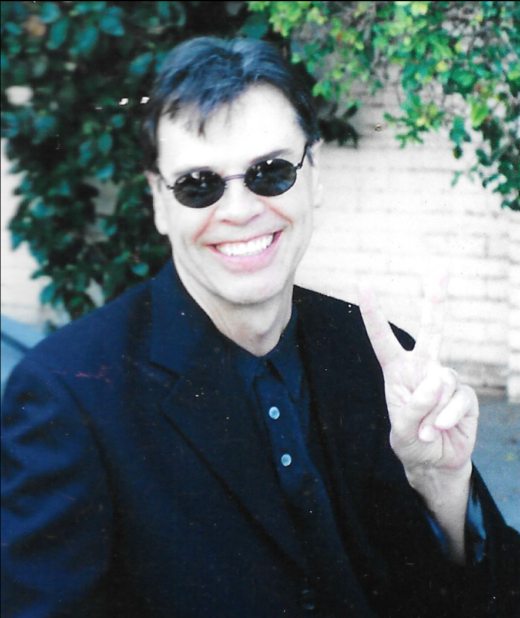
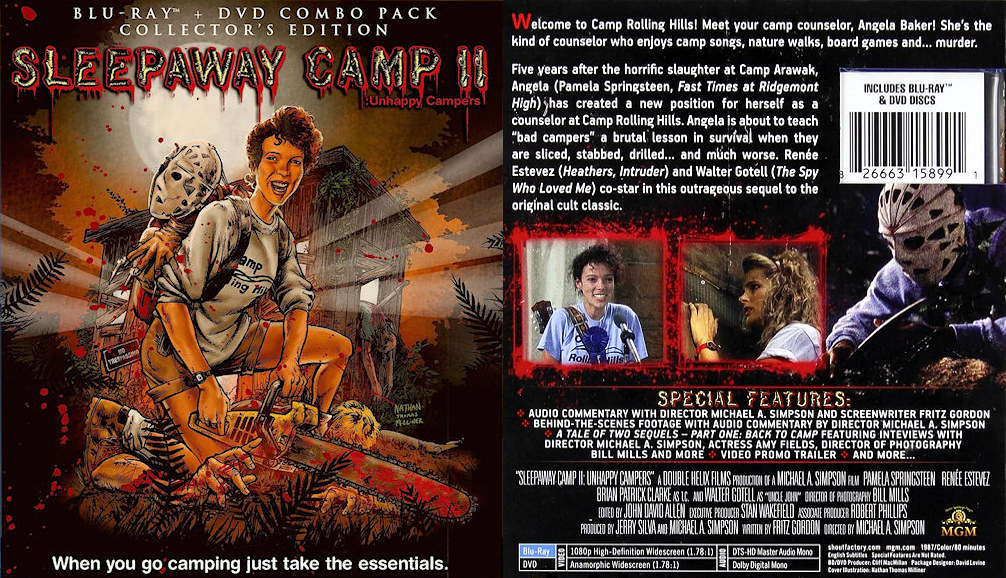
Michael A. Simpson, the Emmy and Peabody Award-winning filmmaker who helmed Sleepaway Camp 2: Unhappy Campers and Sleepaway Camp 3: Teenage Wasteland, sat down to discuss these horror classics through an exchange of emails from his home in Los Angeles where he’s partnered with his wife, Judy Cairo, in a successful movie and television development and production company. The cult producer/director is open in discussing the movies, his background, and the film making process.
Sleepaway Camp Films: How did you get involved as producer and director of the Sleepaway Camp sequels?
Simpson: The international sales agency Double Helix optioned the sequel rights from Robert Hiltzik, creator of the original Sleepaway Camp. Jerry Silva, one of the producers of that film, was CEO of Double Helix. Jerry secured the rights. His business partner Stan Wakefield brought the projects to me.
SCF: What attracted you to the sequels?
Simpson: I was intrigued by the idea of mixing humor with the slasher-conceit. I didn’t want to make just another movie full of dead teenagers. That felt thematically exhausted, in danger of becoming a parody of itself, even in the 80s. So, I thought why not play with that, stir it up, have a little fun.
SCF: Did you watch Sleepaway Camp before doing the sequels?
Simpson: I did. The movie certainly has an ending folks are shocked by. It’s easy to see why it gained cult status.
SCF: Your sequels contributed to self-referential comedy and pop culture references in teen horror films. The Av Maniacs review noted that Unhappy Campers using self-referential pop humor was an influence for later movies like Scream and helps make Unhappy Campers still fresh. You even have a meta moment in Unhappy Campers when a camper about to be dispatched by Angela, says straight to camera “but I didn’t do anything” implying she knows the rules of the teen slasher movie she’s in. That was unheard of at the time.
Simpson: For me, the sequels are where slasher horror and comedy meet in a dark alley.
SCF: It’s said you put the “camp” in Sleepaway Camp. Unhappy Campers is noted for its campy slasher approach, with some fans considering it better than the original.
Simpson: It probably comes down to whether you enjoy humor with your body count.
SCF: Joe Bob Briggs, the renowned critic known for his “redneck” wit and reviewing style, has discussed and featured the Sleepaway Camp franchise on his show, The Last Drive-In, notably hosting a well-received marathon featuring Unhappy Campers. Viewers often talk about its dark humor.
Michael: The sequels are as much a parody of the teen slasher genre as a continuation of Sleepaway Camp. Campers who grok that seem to enjoy walking down that red-stained brick road.
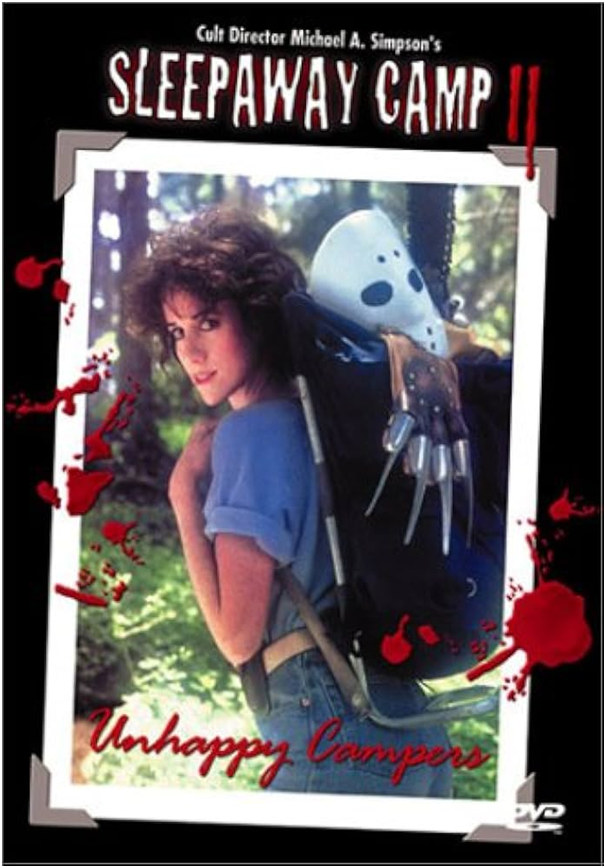
SCF: Unhappy Campers has characters named after the Brat Pack. Rob. Demi. Charlie. Emilio. You have kids dressed as Freddy Krueger and Jason playfully battling each other, which predates the Freddy vs Jason movie by 15 years. In a way it was like The Simpsons series, which is famous for predicting real-world events. And as an aside, you also seemed to foresee ED meds with the “secret sauce” in your movie Fast Food. But back to Unhappy Campers, Angela dresses as Leatherface and dispatches the Freddy and Jason pranksters with a chainsaw. Whose idea was that?
Simpson: I lay that at the anointed feet of Fritz Gordon who wrote the sequels.
SCF: Let’s talk about Fritz.
Simpson: You might say I met Fritz through Michael Hitchcock. Fritz is the pen name Hitchcock used to write the sequels. For years, campers thought Fritz was a real person. I played along.
SCF: Those movies were Hitchcock’s first writing credits.
Simpson: He went on to write for the Tv series Mad TV, Glee and Crazy Ex-Girlfriend. He’s also a well-known character actor. A talented guy.
SCF: When did you first meet him?
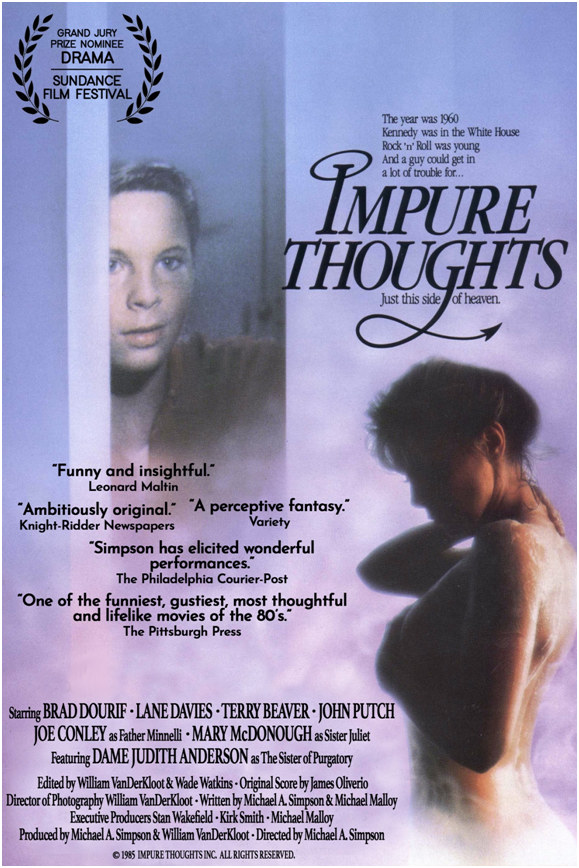
Simpson: At the Sundance Film Festival. He saw Impure Thoughts, liked it, and introduced himself.
SCF: Impure Thoughts was your first feature. It was an official Sundance selection and Grand Jury Prize nominee for Best Drama Picture that year. Impressive.
Simpson: I was surprised. A bit overwhelmed, really. We had a small budget. Shot the movie in 13 days. Did the edit in about two weeks. No ADR. About two hours for the sound mix.
SCF: The movie got very good reviews. Ed Blank of The Pittsburgh Press called Impure Thoughts “one of the funniest, gutsiest, most thoughtful and lifelike movies of the ’80s” when it had its limited theatrical release. You had Brad Dourif for one of the leads. Brad’s known to campers for his horror films and as the voice of the evil doll Chucky.
Simpson: Brad had been Oscar-nominated for One Flew Over the Cuckoo’s Nest. We got the script to him through a mutual friend. I was excited to work with him.
SCF: The leap in terms of tone from Sleepaway Camp to Unhappy Campers. Successful as it turned out to be, it was gamble. What was the catalyst for the change?
Simpson: Hitch brought the humor to the sequels. He’d been in the LA improv troupe “The Groundlings.” I was impressed by his razor-sharp wit.
SCF: Sleepaway Camp provided the springboard for the transgender turn you introduced in Unhappy Campers.
Simpson: I loved the idea of having Angela go under the knife for a little snip, snip. It felt fresh. And it allowed Angela to develop and evolve as a character.
SCF: That’s one of the most unique twists in the Sleepaway franchise. Angela becoming male-to-female transgender. And a bit controversial.
Simpson: Some fans really liked it. Others didn’t.
SCF: Unhappy Campers received particularly good reviews when it was released on DVD. AV Maniacs gave the movie four stars, calling it a “cult classic.” The review said “there’s no question that this is one of the better horror movies from the 80s.”
Simpson: I generally don’t read reviews but someone sent me that one.
SCF: It appears that the critics caught on to what the fans knew all along. Not only is Unhappy Campers the best of the SC movies but it’s one of the best horror films from the post-Golden Age era of slasher flicks. It’s good to see the movie get credit for its stylish and imaginative kills. Av Maniacs called them “some of the most memorable of any horror film.” That’s a helluva compliment.
Simpson: A richly deserved nod goes to Bill Johnson. His affectionate nickname is “Splat.”
SCF: Those were Bill’s first movies as a special makeup effects artist. He went on to do makeup effects for The Walking Dead, Stranger Things, Hunger Games. Loads of other series and movies.
Simpson: I think he’s one of the best in the business at what he does.
SCF: For low-budget horror, you had quite a cast. Seasoned vets like Walter Gotell. He played the head of the KGB in a bunch of James Bond movies. And Michael J. Pollard, who had been Oscar-nominated for Arthur Penn’s Bonnie and Clyde. Horror fans remember Michael J. from House of 1000 Corpses. And then you had fresh faces like Renée Estevez.
Simpson: I wanted Renée for Molly the first time I met her. There was an adorable innocence about her that I thought would be perfect for that character.
SCF: AV Maniacs called Pamela Springsteen’s performance “wonderful and very memorable.” How about her?
Simpson: When Pam read, Angela came to life right in front of me. I knew she should play the Angel of Death. I offered her the role the same day.
SCF: Were there other contenders for the Angela role?
Simpson: Tracy Griffith read for the part. I cast her in Teenage Wasteland (SC3) as Marcia. I liked her performance so well, I cast her in Fast Food. Later, she left acting and became a world-class chef.
SCF: Tracy. Melanie Griffith’s sister. Renee. Charlie Sheen’s sis. Pam. Bruce Springsteen’s sister. It’s been humorously noted your cast was like the sisters of the rich and famous.
Simpson: I remember the night Pam and Renee met over dinner. It was fun waiting to see which one would bring it up first.
SCF: Pam’s now a photographer. She did Bruce’s album covers for Human Touch, Lucky Town and The Ghost of Tom Joad, and was cinematographer for the “Ghost of Tom Joad” music video.
Simpson: She did stills for Price of a Broken Heart, a movie my partner Judy Cairo executive produced. When I saw Pam again, she was her same sweet self. She gave me one of her art photos as a present. She’s gifted. Great eye for composition.
SCF: It appears she gave up acting.
Simpson: It’s a shame. She’s a natural. Playing a transgender, psychopathic killer…boy, talk about going boldly. It would’ve been easy to be over-the-top and too broad or worse, too dark and somber. I thought she found the perfect balance.
SCF: For technical purists, were the films shot in1.85:1 widescreen or 1.33:1 full frame?
Simpson: If memory serves, they were shot 1.85:1. Bill Mills, the director of photography, would probably remember for sure.
SCF: How many days of principal photography?
Simpson: I believe 16 days for each movie. To stay on time and on budget, we couldn’t really do more than about two takes. Often only one. Little rehearsal. No table read. I brought actors to camera. Not camera to actors. I had no video monitor. If the take was good for camera and sound we moved on. Very much gun and run.
SCF: Why did the MPAA clampdown on the violence in Teenage Wasteland?
Simpson: They got a fly up their nose about the Cindy death scene and also the way Lilly, the camp counselor, was killed. When Cindy was dropped from the flagpole and her head smashed on the concrete, we saw her brains splatter. We used pig’s brains. The MPAA gave us an “X” rating because of that shot. It had to be deleted since I was contractually required to deliver a film with a R-rating.
SCF: The MPAA later renamed the X classification, right?
Simpson: Yeah. It’s now called NC-17.
SCF: And Lilly’s death?
Simpson: We had a shot of the lawn-mover running over Lilly, who’s buried up to her head. I had watermelon blowing out the side of the mower. A cheap blood splatter effect. I was told it made some woman at the MPAA nauseated. The shot had to be taken out. Waste of a good melon. I offered to send her one.
SCF: Fans really love the gore footage cut from the movies that was included as a DVD extra on the Anchor Bay release. You just gotta love the brains splatter in the flag pole scene.
Simpson: I’m glad the footage found its way out of the cupboard. A mind – and a brain splattering – are terrible things to waste.
SCF: DVD sales for the sequels were huge. Anchor Bay sold out its first pressing and rushed another pressing out. How does it feel to be hailed as a “cult director?” That moniker is splattered above the title on the sequel DVD boxes.
Simpson: I’ve been called worse. I feel I should be serving Kool-Aid or something.
SCF: I understand that the MPAA wasn’t the only party pooper. You had to wrestle with the Georgia State Department of Labor. Tell us about that.
Simpson: In SC2, there’s a scene where kids are swimming in the pool. There’s a shot of Valerie Hartman’s character climbing out of the pool. Her nipples are visible through her wet tee.
SCF: Valerie’s character Ally holds a special place in the hearts and trousers of many campers.
Simpson: There was a line in the script, something like, “Hey Emilio, check out those nips.” We had guys from the labor department on the set because we had minors working. In their infinite wisdom they decided we couldn’t have someone under the age of eighteen say the word “nips” so we changed the line to “Hey Emilio, party hats at two o’clock.” They didn’t have a problem with that. For me it was like, pardon my dust, I’m just trying to get a movie made on a budget.
SCF: Let’s talk about the path you took to becoming a writer, producer and director and creating the Sleepaway Camp sequels. What’s your origin story?
Simpson: Mine started at the University of Georgia. No radioactive spiders were involved. I studied film and drama. Put myself through school playing music.
SCF: I read that Wayne Knight, whose been in a bunch of stuff – Jurassic Park, Seinfeld, Five Nights at Freddy’s – was a drama student at the time.
Simpson: Yeah. We had classes together. Talk about a guy with huge talent.
SCF: You studied acting. Did you have a desire to be an actor?
Simpson: No. I’m more comfortable behind the camera or in front of a computer. But to direct, it’s important to understand the acting process. The craft. How an actor creates a character. I believe if you aspire to direct, you should study acting.
SCF: I spoke with actors who worked with you. They said they enjoyed your directing style.
Simpson: I like sets calm and positive. That creates an environment, a safe space, for actors to play in the sandbox and pretend. The only drama on set should be in front of the camera.
SCF: Play pretend. That’s an interesting way to look at acting.
Simpson: Actors use their imagination, develop a character until they believe they are the character. They become the character. It’s using their imagination to pretend. What Stanislavski called the “magic if.” Know who are great actors? Kids. They tie a towel around their neck and they’re Superman. Humans aren’t the only species that use imagination like that. Researchers say our closest living relatives, bonobos, have the ability to pretend and imagine. So it’s a primal instinct. I’m sure it goes back to Homo erectus dancing around a campfire millions of years ago.
SCF: Across the films you produced or executive produced, you’ve had amazingly talented actors. Jeff Bridges. Robert Duvall. Anthony Hopkins. All Oscar winners. Were their approaches to developing a character different?
Simpson: In some ways, yes. For Crazy Heart, Jeff lived in the skin of his character Bad Blake. He stayed in character on and off the set. Bobby was different. He’d be relaxed, just being himself, and then he be called to set and, in a beat, be in character. Tony was meticulous in his preparation for Kidnapping Mr. Heineken, then in the moment, he would relax, instinctively letting the character play through him. Watching them work, I was in awe. It was a master class in acting. But each had a different approach to their craft.
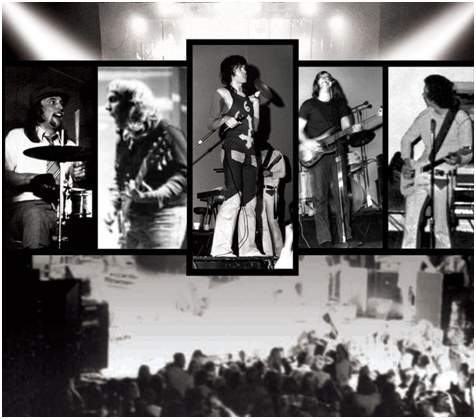
SCF: For the DVD release of the Sleepaway sequels a bonus extra was the song “More Love” recorded by your band Ravenstone. Most campers only know you through your movies. It was probably a surprise for many of them to learn you had a music career before you became a movie director.
Michael: “More Love” was a song the band wrote and first recorded in our university days.
SCF: I read Ravenstone created a political party that took over the University of Georgia student government in the early 1970s.That sounds like Barry Shear’s classic Wild in the Streets. In Gordon Lamb’s book Widespread Panic in the Streets of Athens, Georgia, he wrote that your band blew away the traditional gap between talk and action. You supported gay rights, legalization of marijuana, freedom of speech. You championed voter registration, opposed the Vietnam war.
Michael: I felt performing on stage with the band helped prepare me to direct. In a way it’s similar to acting, especially stage acting. When you perform, you project energy for a live audience. With each song you take on a persona , a character. You tell a story. Like the Doors’ Jim Morrison said in the song “The End,” you put your boots on, take a face from the ancient gallery and you walk on down the hall.
SCF: Ravenstone was at the beginning of the what became the internationally acclaimed Athens, GA music scene. Your band predated the B-52s, R.E.M. and Widespread Panic. All those groups came out of that scene. In John Hunter’s biography of R.E.M., Maps and Legends, The Story of R.E.M., he called Ravenstone “Athens most significant band of the early 70s” that “pre-figured” R.E.M. in many ways.
Simpson: I guess maybe we were their bastard uncle. Ravenstone, its original line up, was only together about a year. Our music never developed the way those other groups you mention did.
SCF: Hunter noted that the band performed at the first openly gay dance in the south, headlining with a drag queen. And you were threatened with arrest while playing for a voting rights rally on campus.
Simpson: I spoke at the 50th anniversary of the gay dance in Memorial Hall where the dance occurred. A man shared with me how that dance changed his life. He’d been a student, closeted. Lonely. Alienated. The dance gave him courage to come out. He met someone who became his life partner. He tearfully hugged me, thanking me. It was a very emotional moment.
SCF: You spent time paying your dues as a commercial and documentary director. Your break came when you developed two series for Turner Broadcasting. What were those?
Simpson: Portrait of America. That was TBS and TNT’s first original series. I was the writer, and a producer and director of “Portrait of Georgia,” the pilot for the 60-episode documentary series.
SC: “Portrait of Georgia” won Emmys and Turner Broadcasting’s first Peabody Award. Pretty auspicious start to your television career.
Simpson: Then I helped create, write and direct another TBS documentary series, World of Audubon. The exciting part for me were the people I had the opportunity to interview. Former President Jimmy Carter. Civil rights icon Andrew Young. Sally Ride, the first American woman in space. Legendary CBS news anchor Walter Cronkite. So many others.
SCF: Prior to the Sleepaway Camp sequels you directed a comedy, Funland, about Bruce Burger, an eccentric hamburger franchise clown who’s working the opening of an amusement park. I found its dark humor much in the tone of the Sleepaway sequels that you later directed.
Simpson: Funland was the first movie written by Bonnie Turner and Terry Turner. We wrote Funland together based on my story treatment, although they did the heavy lifting for the script.
SCF: The Turners went on to huge success. They were writers of the Wayne’s World movies and creators of the TV series 3rd Rock From the Sun and That 70’s Show.
Simpson: Bonnie and Terry are two of the most talented people I’ve ever worked with. And spit-your-coffee-out funny. I love them.
SCF: Unhappy Campers. Teenage Wasteland. Which is your favorite?
Simpson: I’d say Unhappy Campers. Teenage Wasteland was rushed. We had very little preproduction, essentially one weekend. Principal for Unhappy Campers wrapped on a Friday and we started production the following Monday for Teenage Wasteland. We got the greenlight for Wasteland the first week of Unhappy Campers production. I was finalizing cast for Wasteland, tweaking its script, while producing and directing Campers. I was the only producer so it was a lot to shoulder. The cliché is art is never completed only abandoned. No one would every accuse those movies of being art, but we had very limited resources, time and budget. Looking back, if I’d had more to work with, I feel the movies could have been better.
SCF: How about your favorite scenes and kills?
Simpson: One of my favorite scenes was at the abandoned cabin in Unhappy Campers. Molly finds Angela and they talk. It’s this little oasis of intimacy in the midst of the carnage. I felt you learned something about Angela’s character. In terms of gore, the Brooke and Jodi barbecue in SC2 was tasty. The power drill death for Mare. For SC3, Peter’s firecracker up his nose.
SCF: You were interviewed for the 2015 releases of Sleepaway Camp 2 & 3 on Blu-ray, and the movies have since been reissued several times more. Are you surprised at the longevity and demand for your films?
Simpson: I am. The fun part is meeting campers who watched the movies in the ’80s and have since watched them with their kids and now their grands. Three gens of happy campers.
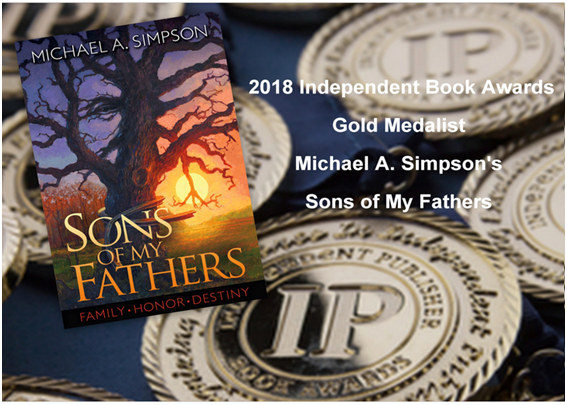
SCF: You’ve had a diverse career. Novelist. Filmmaker. Recording artist. Political activist. You’ve served on the boards of publicly-traded companies. Films you executive produced and Judy produced have won Oscars, Golden Globes, Independent Spirit Awards, Baftas, Grammys. You’ve been a newspaper columnist. And I might add you’re an ordained priest, a Scottish Lord and a Kentucky Colonel.
Simpson: Guilty on all counts. I throw myself on the mercy of the court. Those titles. Priest. Lord. Colonel. All have fun stories about them. Perhaps another time.
SCF: Creatively, what do you enjoy most?
Simpson: These days, writing.
SCF: In Killian Gore’s interview with you for his book, What’s Your Favorite Scary Movie, you named John Carpenter as your favorite horror director and supernatural horror as your favorite horror genre. I’m surprised you haven’t given fans something in that genre.
Simpson: Stay tuned. Something is coming. A supernatural romantic thriller. Campers should hopefully have a first taste of it within the year.
Related Article:
They Came From Atlanta: The Films of Michael A. Simpson
Visit Ravenstone on the Web: